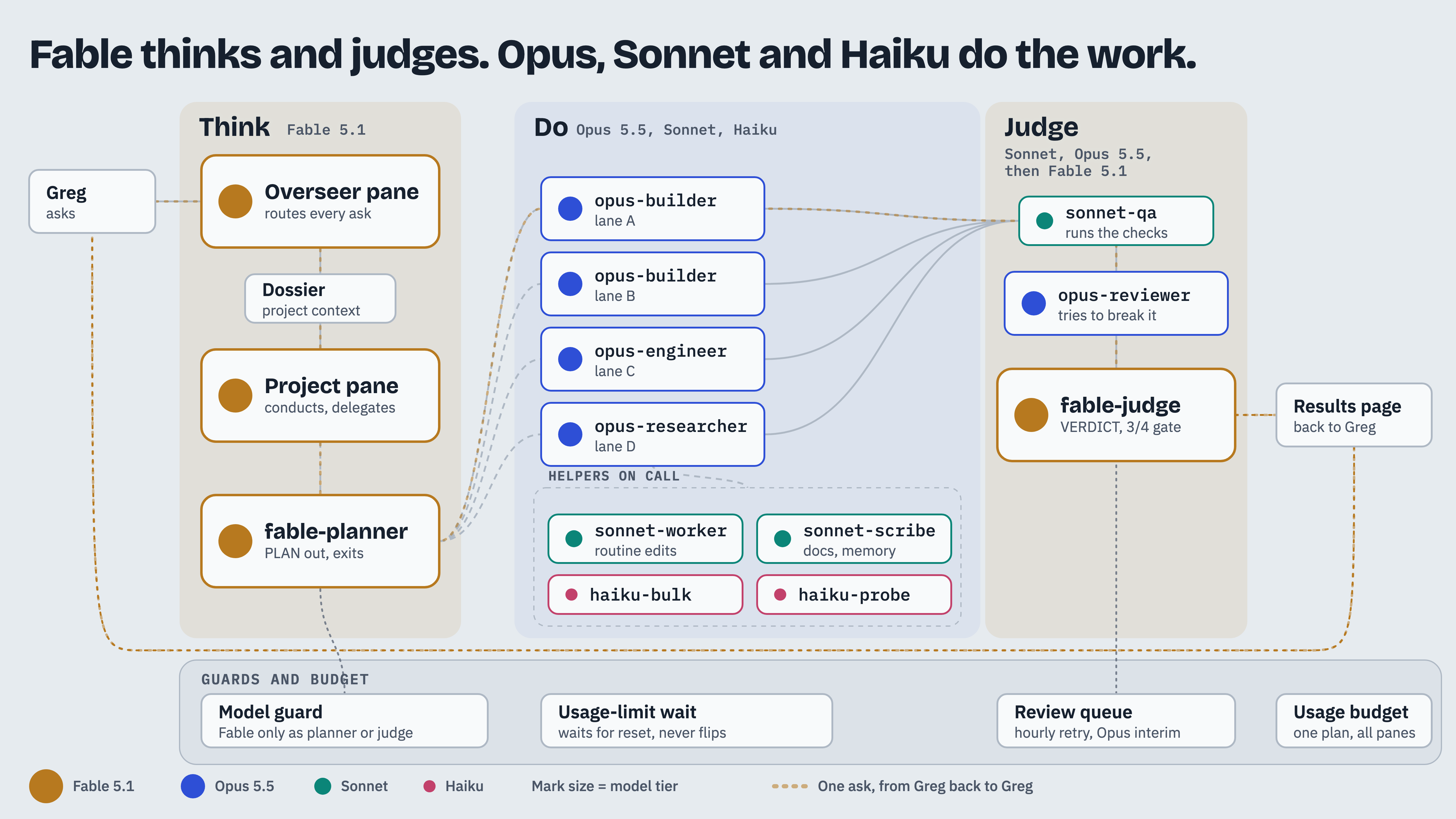
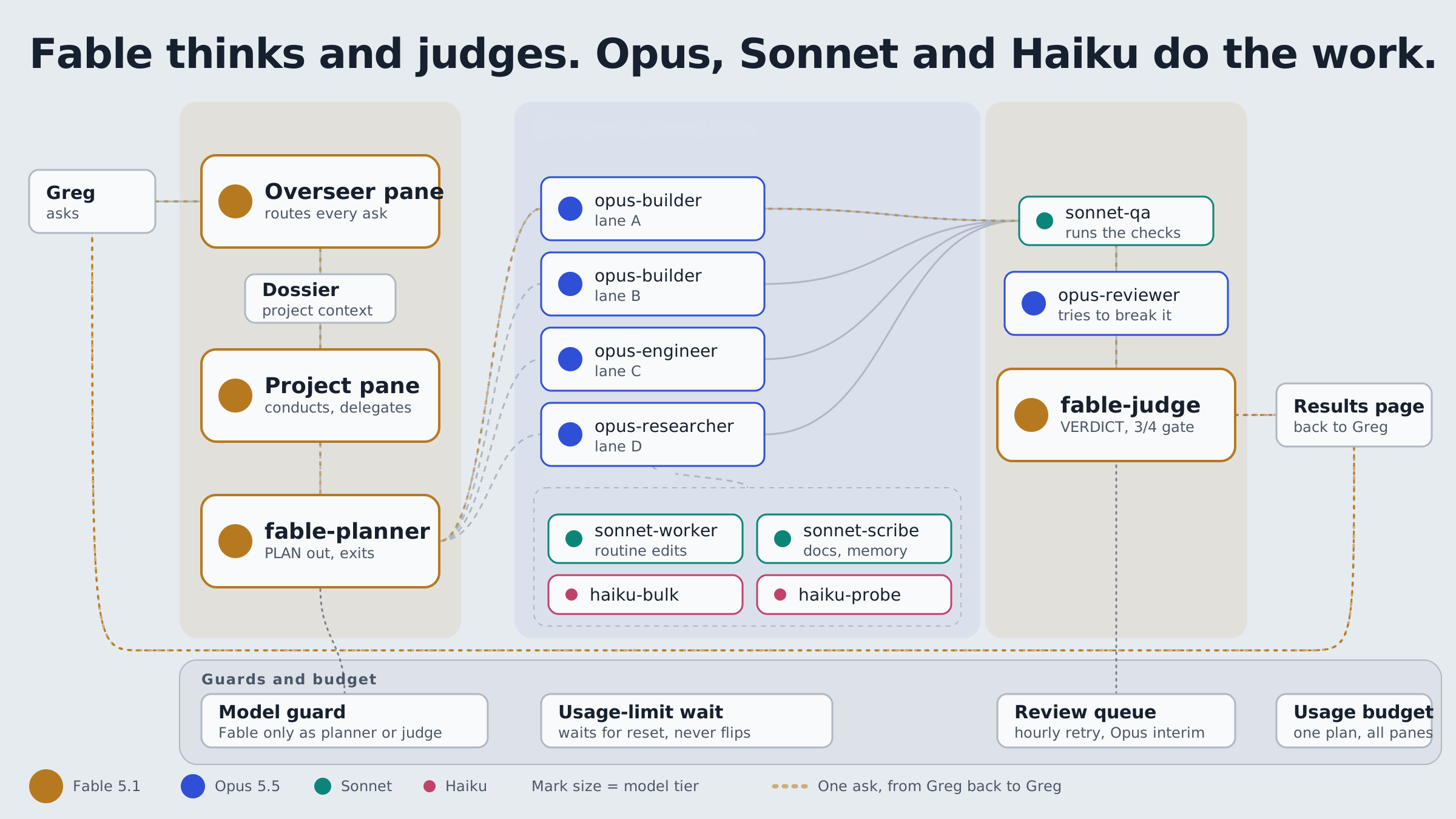
Fable thinks and judges. Opus, Sonnet and Haiku do the work.

How Greg Spero’s Claude agent grid routes work across Anthropic’s model tiers, so the most expensive model only holds the conversation, plans and reviews.

ThinkFable 5.1DoOpus 5.5, Sonnet, HaikuJudgeSonnet, Opus 5.5,then Fable 5.1Guards and budgetHelpers on callGregasksOverseer paneroutes every askDossierproject contextProject paneconducts, delegatesfable-plannerPLAN out, exitsopus-builderlane Aopus-builderlane Bopus-engineerlane Copus-researcherlane Dsonnet-workerroutine editssonnet-scribedocs, memoryhaiku-bulkhaiku-probesonnet-qaruns the checksopus-reviewertries to break itfable-judgeVERDICT, 3/4 gateResults pageback to GregModel guardFable only as planner or judgeUsage-limit waitwaits for reset, never flipsReview queuehourly retry, Opus interimUsage budgetone plan, all panes ThinkFable 5.1DoOpus 5.5, Sonnet, HaikuJudgeSonnet, Opus 5.5, then Fable 5.1Guards and budgetHelpers on callGregasksOverseer paneroutes every askDossierProject paneconducts, delegatesfable-plannerPLAN out, exitsopus-builderlane Aopus-builderlane Bopus-engineerlane Copus-researcherlane Dsonnet-workerroutine editssonnet-scribedocs, memoryhaiku-bulkhaiku-probesonnet-qaruns the checksopus-reviewertries to break itfable-judgeVERDICT, 3/4 gateResults pageback to GregModel guardFable only as planner or judgeUsage-limit waitwaits for reset, never flipsReview queuehourly retry, Opus interimUsage budgetone plan, all panes
Fable 5.1Opus 5.5SonnetHaiku Mark size = cost tier One ask, Greg to Greg Hover or tap any box

Four Claude models, ranked by cost

  1. Fable 5.1 Top tier

    Anthropic’s top Claude tier, and the top of the grid’s cost ladder.

    Does here
    Holds the conversation in every project pane, and runs the bounded planner and judge spawns.
    Cost
    Most expensive. The doctrine calls its budget “the scarce Fable bar”.
    “keep the scarce Fable bar for bounded judgment.”
  2. Opus 5.5 Second tier

    The default worker for anything substantive.

    Does here
    Builds, debugging, research, adversarial review. When unsure between Sonnet and Opus, pick Opus.
    Cost
    About half of Fable, in the doctrine’s words.
    “Opus 5.5 is near-Fable at half the burn,”
  3. Sonnet Third tier

    Routine work only.

    Does here
    QA runs, write-ups, sweeps and boilerplate single-file edits.
    Cost
    Cheaper than Opus. The order comes from the doctrine’s tier list.
    “genuinely ROUTINE work only”
  4. Haiku Fourth tier

    Bulk and lookups.

    Does here
    High-volume extraction, classification, formatting and one-shot probes.
    Cost
    Cheapest. Its own definition says it costs almost nothing.
    “Costs almost nothing; use it freely instead of spending a pane turn on a lookup.”

💡 There is no per-token price table in the source. The cost order comes from the doctrine’s own wording.

Three seats: Fable talks and judges, workers execute

Dialogue seat

Fable 5.1 holds the conversation

Model
Fable 5.1, one per project pane
Does
Talks with Greg, scopes the ask, writes the spec, then hands execution to workers after about three execution calls.
When
Always on, one per project pane, at medium effort.
“A pane is one Fable conversation, not a self-spawning workflow fleet”

Execution seat

Opus, Sonnet and Haiku do the volume

Model
Opus 5.5 by default, Sonnet for routine, Haiku for bulk
Does
Every build, sweep, QA run and lookup. Every spawn names its model.
When
All the time. Multi-part builds split into 2 to 4 parallel lanes.
“opus: THE DEFAULT WORKER for everything substantive; when unsure between sonnet and opus, pick opus.”

Judgment seat

Fable 5.1 plans and judges, then exits

Model
Fable 5.1, as fable-planner or fable-judge
Does
Takes a written contract in and returns a plan or a verdict. It never stays resident.
When
Only in the three cases below, or when Greg asks for Fable by name.
“Fable spawns take a prompt-contract (GOAL / CONSTRAINTS verbatim / ARTIFACTS / SUCCESS / FAILURE / THE ONE QUESTION), return a PLAN or VERDICT, and exit”

Fable spawns in exactly three cases

  1. Planning application development via fable-planner
    “decomposing an app/product build before it is built”
  2. Graphic and visual design direction and critique via fable-planner for direction, fable-judge for critique
    “design direction, layout, visual taste calls”
  3. Reviewing results via fable-judge, the mandatory gate on anything external
    “judging a finished artifact or a completed body of work”
  • ✅ Greg asks for Fable by name: always honored, whatever the task.
  • ❌ Everything else goes to Opus: ambiguity, “go deep”, rule conflicts, debugging, research synthesis, sizing a fan-out.
“Generous within the three cases, strict about scope.”

Twelve workers, two of them on Fable

WorkerModelUsed for
fable-plannerFable 5.1Turns a hard project into an executable plan, then exits. 35 turns max.
fable-judgeFable 5.1Scores a finished artifact 0 to 4. 3 ships. The final gate on anything external. 45 turns max.
opus-engineerOpus 5.5The default worker: implementation, debugging, synthesis, verification.
opus-builderOpus 5.5Multi-file builds with git discipline, one lane per part.
opus-researcherOpus 5.5Research and synthesis that returns findings with citations.
opus-reviewerOpus 5.5Tries to break internal work before it is approved.
interlocutorOpus 5.5A conversation front end that scopes work without spending Fable.
sonnet-qaSonnetRuns tests, link checks and browser passes. Returns pass or fail.
sonnet-scribeSonnetWrites up finished work: docs, changelogs, memory notes.
sonnet-workerSonnetRoutine sweeps and boilerplate single-file edits.
haiku-bulkHaikuHigh-volume extraction, classification and formatting.
haiku-probeHaikuOne cheap lookup instead of a pane turn.

Three guards keep every spawn on its tier

A spawn guard refuses Fable outside the planner and the judge

  • Every agent spawn is checked before it starts.
  • Fable is refused for any worker other than fable-planner or fable-judge.
  • A spawn that names no model is refused too.
  • Greg asking for Fable by name passes, and is logged.
“keep the scarce Fable bar for bounded judgment.”

A blocked Fable review waits in a queue, never skipped

  • When the Fable budget is spent, the final review is queued.
  • A retry runs every hour until there is headroom again.
  • An Opus adversarial judge covers in the meantime.
“NEVER just mention the skipped gate in text.”

A usage limit means wait, never switch accounts

  • A pane that hits its limit waits for the reset.
  • It resumes on the same account.
  • Nothing switches accounts on its own. Only Greg does.
“waits for that limit to reset and resumes immediately on the same account”

Where the turns went: Opus ran 60.5% in the last 7 days, Fable 31%

📊 Share of turns across all sessions, 7 days ending 2026-10-26
  1. Opus 5.560.5%
  2. Fable 5.131.0%
  3. Haiku5.0%
  4. Sonnet1.6%
ModelTurnsShare
Opus 5.5179,75460.5%
Fable 5.192,05631.0%
Haiku14,9555.0%
Sonnet4,7601.6%
Other5,5311.9%
All turns297,056100%
  • 📈 91.8% of worker turns ran on Opus: 169,266 of 184,306 subagent turns.
  • 💡 Most Fable turns are the conversation: 81,884 in project panes, 10,172 as planner and judge spawns.
  • ⚠️ Turns are not spend: the doctrine rates an Opus turn at about half the burn of a Fable turn.

Counted from the grid’s own 7-day burn report, run 2026-10-26. Shares are computed from its per-model turn counts.

One ask, end to end, in 11 steps

  1. GregGreg asksFrom his Mac, or from his phone on the road.
  2. Fable 5.1The overseer pane routes itFable 5.1 opens one project pane per ask. It conducts only.
  3. Project fileThe dossier loads firstThe new pane reads the project’s file, so it starts with full context.
  4. Fable 5.1The project pane scopes itFable 5.1 writes the spec, then hands execution to workers after about three calls.
  5. Fable 5.1fable-planner plans itA bounded Fable spawn returns the plan and exits.
  6. Opus 5.5Opus lanes build in parallel2 to 4 Opus 5.5 workers, each with its own files, a shared contract and a merge order.
  7. Sonnetsonnet-qa runs the checksSonnet returns a pass or fail table.
  8. Opus 5.5opus-reviewer tries to break itOpus 5.5 attacks the internal pieces before approval.
  9. Fable 5.1fable-judge scores itA bounded Fable spawn grades the finished artifact 0 to 4. It ships at 3.
  10. Web pageA results page is builtEvery finished request becomes a web page opened in Greg’s browser.
  11. GregGreg reads the pageThe loop closes where it started.

💡 This path combines several separate rules into the typical route of a substantive build. The planner and the reviewer run when a task calls for them.